Kasbu vs Avely vs own.page: Which Loads Fastest? (2026 Speed Test)
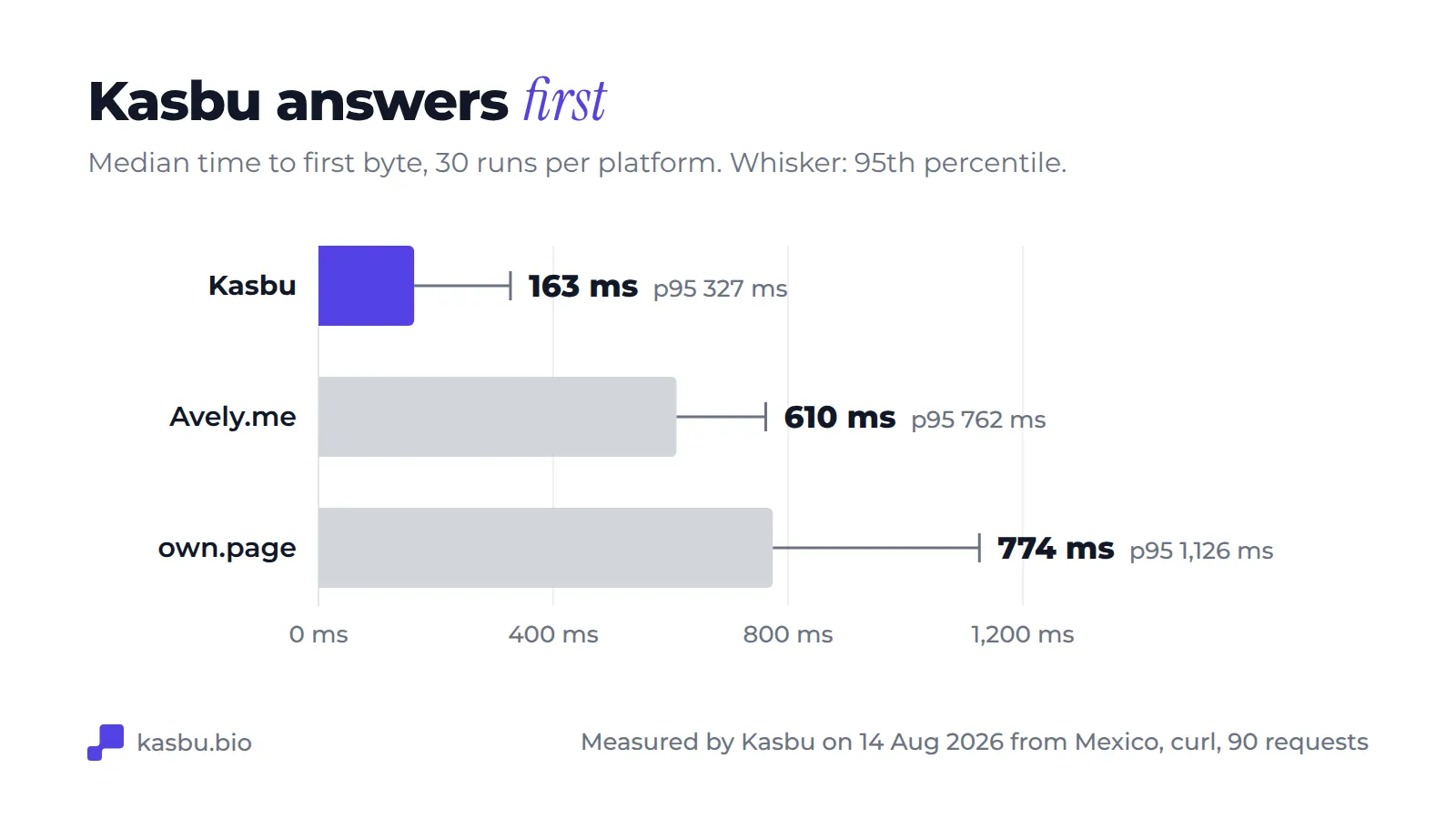
We timed Kasbu, Avely.me and own.page 30 times each, 90 requests in total. Kasbu answered in 163 ms median against 610 ms and 774 ms. Full data, method, limits, and the one thing that can still make your own page slow.
Published · 7 min read · by Kasbu Team
Tags: Link in Bio, Performance, Comparison, Avely, Bento Alternative
Every comparison of link-in-bio platforms argues about card types, pricing and free plan limits. Almost nobody measures the thing your visitor experiences first: how long they stare at a blank screen before your page shows up.
So we measured it. We timed three grid-style platforms, Kasbu, Avely.me and own.page, 30 times each. That is 90 requests in total, cycling between the three so none of them got an unfair slice of the network.
The gap was much wider than we expected.
The results
Time to first byte, which is how long the server takes to start answering at all:
| Kasbu | Avely.me | own.page | |
|---|---|---|---|
| Median | 163 ms | 610 ms | 774 ms |
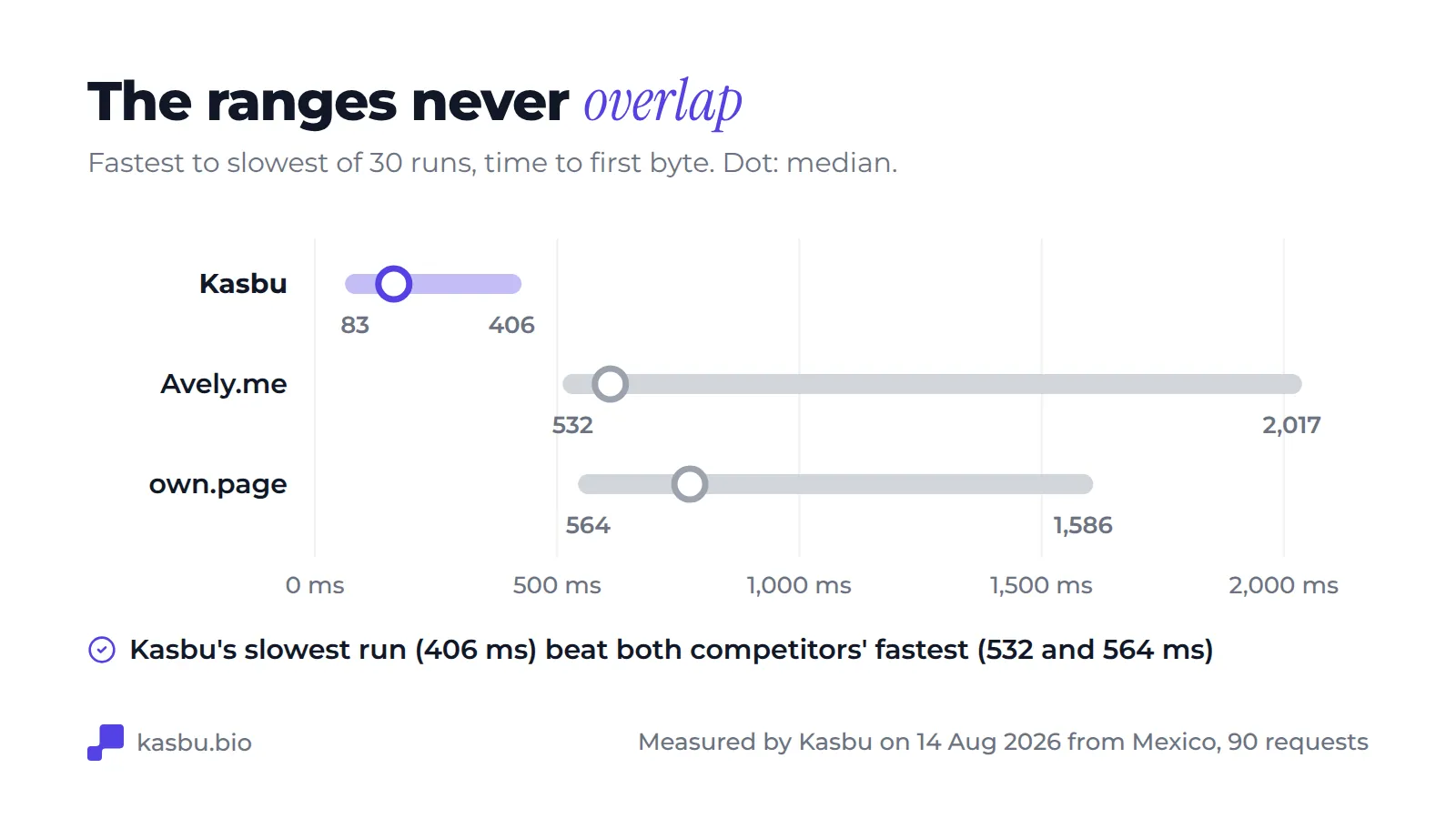
| Fastest run | 83 ms | 532 ms | 564 ms |
| Slowest run | 406 ms | 2,017 ms | 1,586 ms |
| 95th percentile | 327 ms | 762 ms | 1,126 ms |
| Rounds won (of 30) | 30 | 0 | 0 |
The number that surprised us: Kasbu's worst run out of 30 was still faster than the best run either competitor managed. 406 ms against 532 ms and 564 ms. The ranges never overlap. A lucky sample cannot explain a gap like that. Something in how the pages are served is different.
Full page HTML, delivered and complete:
| Kasbu | Avely.me | own.page | |
|---|---|---|---|
| Median time | 212 ms | 978 ms | 899 ms |
| Page weight (compressed) | 3.7 KB | 11 KB | 24 KB |
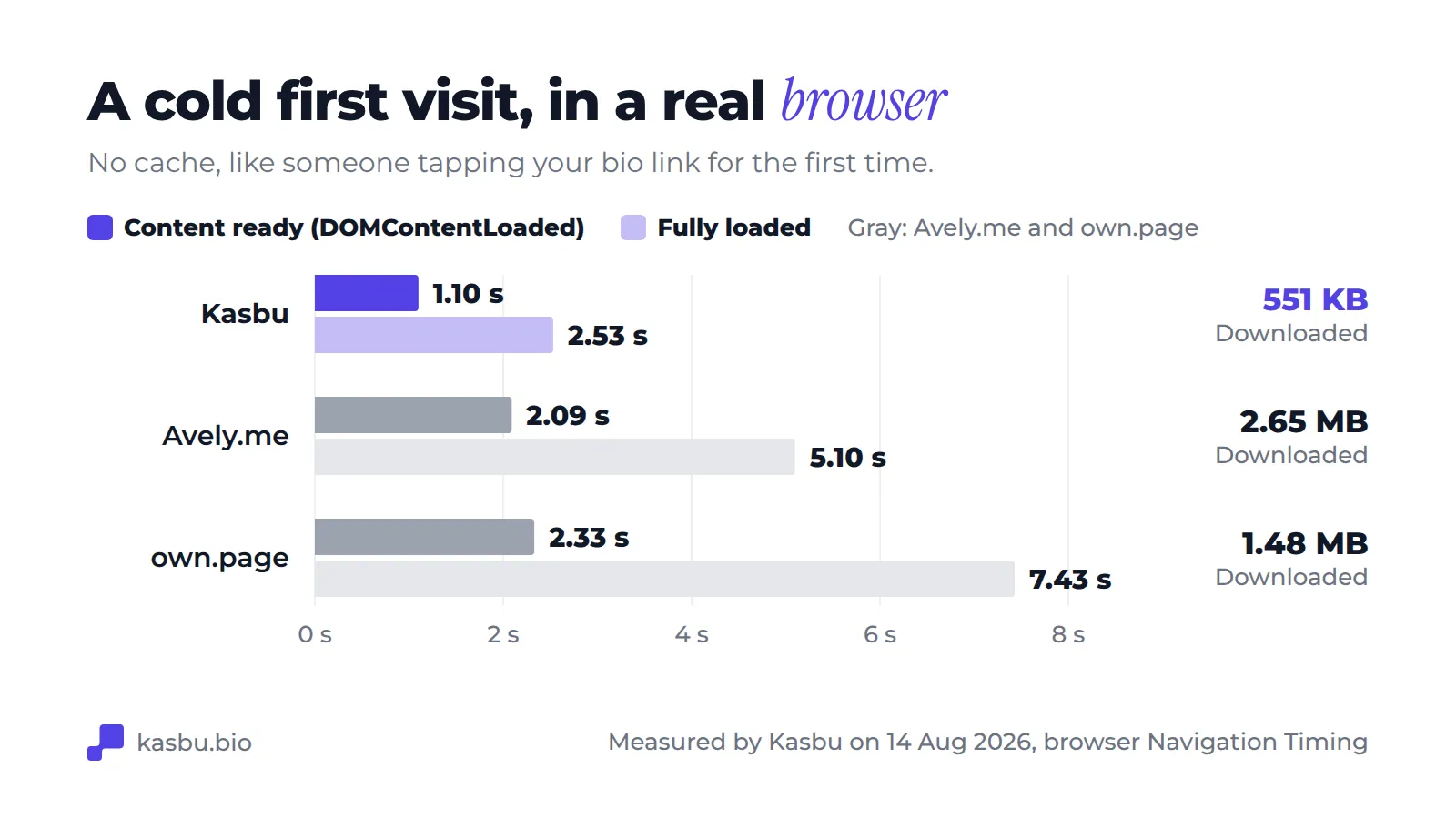
And in a real browser on a cold visit, with no cache, like a first-time visitor arriving from your bio:
| Kasbu | Avely.me | own.page | |
|---|---|---|---|
| Content ready (DOMContentLoaded) | 1.10 s | 2.09 s | 2.33 s |
| Fully loaded | 2.53 s | 5.10 s | 7.43 s |
| Total downloaded | 551 KB | 2.65 MB | 1.48 MB |
Why the gap exists
Two reasons, and neither one is a trick.
Kasbu is served from the edge. Your page sits on a CDN with servers around the world, so a visitor gets an answer from a machine near them instead of from a single origin server somewhere else on the planet. That accounts for most of the 163 ms.
The page that arrives first is tiny. 3.7 KB compressed, roughly the size of a paragraph of text. Your cards, images and embeds stream in right behind it, and the browser has something to work with almost immediately instead of waiting on a 24 KB document.
Why this matters more for a bio link than for a normal website
Nobody waits patiently for a link in bio. It is a hop between two things they actually want, and every part of that moment works against you:
- They arrive from an app, not from search. No cache, no warm connection, nothing preloaded. Every visit is a cold start.
- They are inside an in-app browser. Instagram and TikTok open links in their own stripped-down browser, which runs JavaScript slower than Safari or Chrome.
- They are on mobile data, often bad mobile data. A slow server turns into a much slower page when the network is already struggling.
- Going back costs nothing. The back gesture sits right there under their thumb.
Google's research on mobile sites found that 53% of visits are abandoned if a page takes longer than three seconds to load. That figure is from 2016 and from ordinary websites, so treat it as a direction rather than a rule for your audience: the longer the wait, the fewer people are still there when the page appears.
The loss also compounds. Every visitor who gives up before your page renders is a click that never reaches your store, your booking link or your newsletter, and you will never see it in your analytics, because they left before anything loaded enough to be counted.
The honest part: a fast platform can still host a slow page
This is the finding most relevant to you, and it does not flatter us.
When we looked at which resources took longest on the Kasbu page we tested, the eight slowest were all third-party embeds. A YouTube iframe took 7 to 8 seconds to settle. An Apple Music player, a map snapshot and analytics accounted for most of the rest. Kasbu's own code finished in about one second, and then the page sat there waiting on other companies' servers.
We saw the same effect from the other side. Everything above measures a first visit, which is the normal case for a bio link. On a repeat visit, where the browser already holds most of the files, the order flips: across our warm runs the Avely page landed between 471 and 672 ms while the Kasbu page landed between 831 and 1,175 ms. Both are fast at that point, and the gap is a few hundred milliseconds, but it goes to Avely, because a fully static page has nothing left to fetch while ours kept re-requesting embeds that can never be cached.
None of that changes who answers first. Time to first byte is the server's own speed and the cache never enters into it, which is why Kasbu won all 30 of those rounds. What changes on a repeat visit is everything after the first byte, and that part depends on your cards.
The platform gives you a fast floor. What you build on top of it decides your ceiling.
Practical takeaways for your own page:
- Put your most important card first, at the top. It renders in the first second whatever else is on the page.
- Be deliberate with video embeds. One YouTube or Apple Music card is fine. Four of them stacked at the top means your visitor watches a loading state.
- Compress images before uploading. A 4 MB photo does not look better on a phone screen than a 400 KB one, it just arrives later. It also eats into the 150 MB of storage on the free plan.
- A map card is beautiful and expensive. Worth it if you are a physical business people need to find. Not worth it as decoration.
- Fewer, better cards beat more cards. The median Kasbu page uses about four.
How we tested, and what we cannot claim
Benchmarks should be reproducible, so here is what we did and where it falls short.
Method: 30 rounds, cycling Kasbu, then own.page, then Avely, and repeating, so network conditions were shared evenly across all three. 90 requests in total, measured with curl at the network level plus browser Navigation Timing for the render metrics. Measured on 14 August 2026 from a single location in Mexico. The URLs tested were kasbu.bio/kasbu, own.page/elitza and avely.me/work_louder. All three platforms have shipped changes since then, so a new run could give different numbers.
What this does not prove:
- One location, one network. From Europe or Asia the absolute numbers would shift. The edge CDN advantage should hold, but we did not measure it from there.
- One page per platform. Each page has different content. That is why we lead with time to first byte, which is the server's speed and nearly independent of what sits on the page, and treat the full-load numbers as directional.
- Speed is one variable. It is not a verdict on either competitor as a product. Both are real, well-built tools, and our head-to-head comparisons of Kasbu vs own.page and Kasbu vs Avely cover everything else.
- Load-event timings are noisy. Across runs they swung by several seconds on every platform, ours included, because third-party embeds and analytics behave unpredictably. Time to first byte was stable and repeatable, so that is the number to trust.
Frequently asked questions
Which link in bio platform is fastest, Kasbu, Avely or own.page?
Kasbu, by a wide margin in our testing. It answered in 163 ms median against 610 ms for Avely.me and 774 ms for own.page, and it won all 30 rounds. Its slowest single run was still faster than the fastest run of either competitor.
Does page speed affect my Google ranking?
Yes, though less than people assume. Google uses Core Web Vitals as a ranking signal, but relevance and content matter more. The bigger effect of speed is indirect: a fast page keeps visitors, and visitors who stay send better engagement signals than visitors who bounce.
Will my Kasbu page be as fast as the one you tested?
The server side, yes, because that is the platform and it is the same for every page. The rest depends on what you put on it. A page of links and images will be faster than the one we tested. A page stacked with video embeds will be slower.
Do embeds hurt enough that I should avoid them?
No. An embedded Spotify player that lets someone listen without leaving your page is worth a second of loading. The problem is stacking several of them at the top. Use them where they earn their place.
Does a custom domain slow my page down?
No. Custom domains on Kasbu Pro are served from the same edge network as kasbu.bio addresses.
How do I check my own page speed?
Run your URL through Google PageSpeed Insights. Test the mobile score rather than desktop, because that is where nearly all link-in-bio traffic lands.
Your bio link gets one chance, on a bad connection, from someone who is already halfway to leaving. A fast page is what gets it seen at all. If you want to try it with your own cards, create a Kasbu page for free: 25 cards, all 36 card types and every design option, no credit card.